


Why Thousands Trust Us and Keep Coming Back
Delivering quality and consistency that customers rely on.
Subtotal: $139.00
Your CO alarm is legally required to stay silent below 30 PPM. Airoso isn't.
Every standard carbon monoxide alarm on the market is built to the UL 2034 safety standard — a standard written to prevent nuisance calls to fire departments, not to give you early warning. It permits alarms to stay completely silent below 30 PPM, and gives them up to four hours to sound at 70.
Which means the months when a cracked heat exchanger or a backdrafting water heater is first leaking? Your alarm displays nothing. Not a number. Not a light.
A healthy room reads zero. Airoso shows you the real number from 0 PPM up.
How it works
Airoso reads your air continuously and responds in three stages instead of one:
You get the early warning and the last line of defense. One device, both jobs.
Features
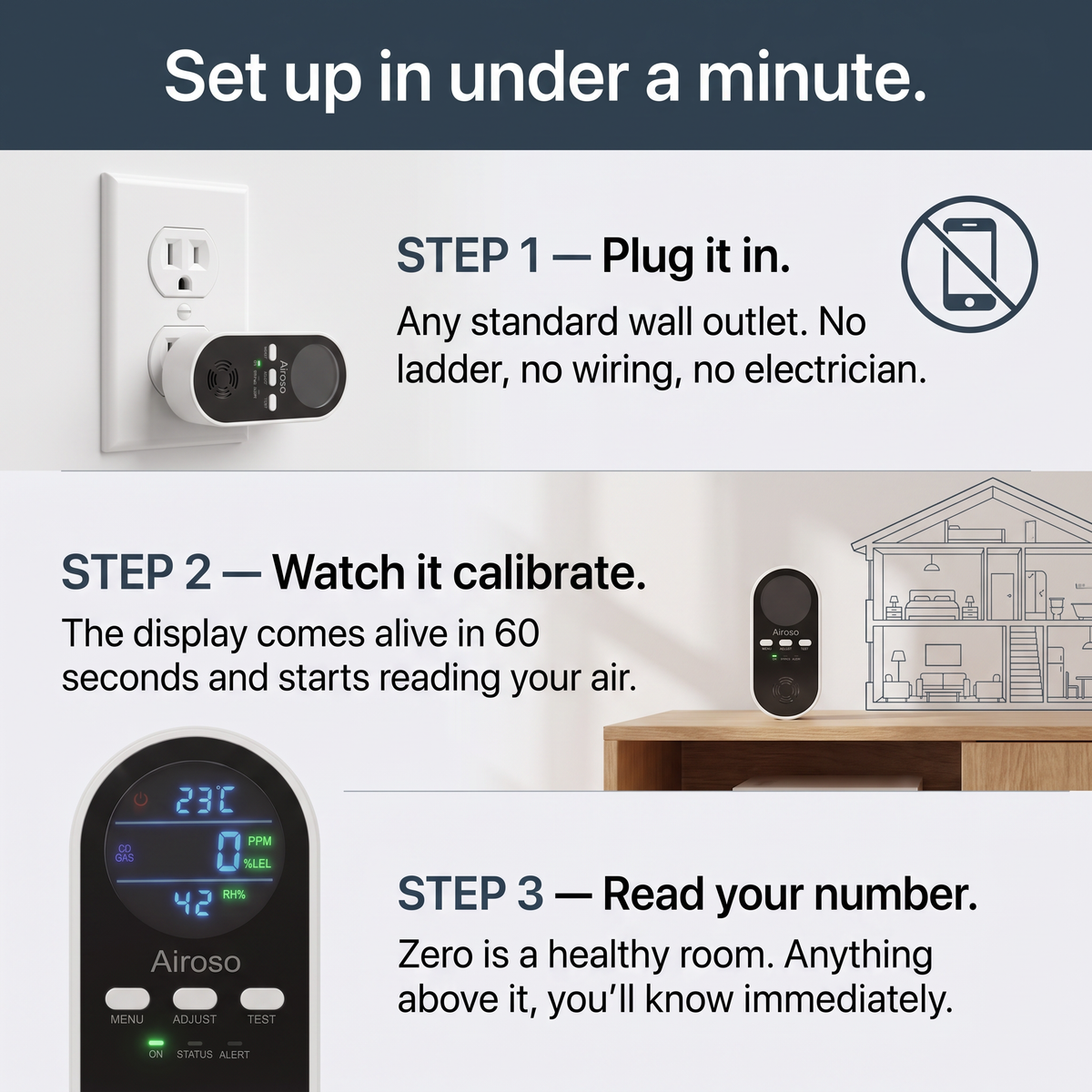
Setup takes under a minute. Plug it in, let it calibrate, read your number.
Won't this go off constantly? I have a gas stove.
No. That's the whole point of the tiered system. Cooking on a gas range can push a kitchen into the 5–15 PPM range briefly — Airoso shows you that as a number and a quiet notification, not an 85dB alarm. The full alarm only sounds at the same emergency thresholds any certified detector uses. You get the information without the nuisance.
I already have a CO detector. Why do I need this?
Your current detector is a compliance device. It's built to the UL 2034 standard, which permits it to stay silent below 30 PPM and gives it up to four hours to sound at 70. It's designed to wake you during an emergency — not to tell you a leak is developing. Airoso does both.
Is 9 PPM actually dangerous?
Not immediately, and we don't claim otherwise. 9 PPM is a leak alert, not a danger alert. A healthy home reads 0–2. If yours is sitting at 9, something is producing carbon monoxide that shouldn't be — usually a furnace, water heater, or dryer vent. It's a reason to call a technician, not a reason to evacuate.
What do I do if I get a reading?
Under 25 PPM: ventilate the room and call an HVAC technician to inspect your combustion appliances. Over 25 PPM or if anyone feels unwell: get everyone outside and call your gas company or fire department. If the full alarm sounds, treat it as an emergency and leave immediately.
Is it UL certified?
Yes — Airoso meets UL 2034, the same emergency safety standard as any retail CO alarm. The difference is what it does below that threshold. [Confirm before publishing — this claim needs supplier documentation behind it.]
Does it need wiring or an app?
Neither. It plugs into any standard wall outlet and reads on the device itself. No electrician, no ladder, no hub, no subscription.
How loud is the alarm?
85dB at 10 feet at emergency levels — loud enough to wake a household through a closed door.
How many do I need?
One per floor is the general guidance, prioritizing sleeping areas and any floor with a gas appliance, furnace, or attached garage. A single unit reads the room it's in.
Free shipping. Ships within 1-2 business days, arrives in 10-14 business days.



This CO monitoring system offers reliable, continuous detection to protect loved ones from invisible dangers. Easy to use and always on, it keeps you informed daily.
Delivering quality and consistency that customers rely on.

Carbon Monoxide Monitoring System
Consistent and Accurate Readings
Users reported peace of mind with reliable CO level data.
Enhanced Home Safety
Families felt more confident in protecting loved ones from unseen dangers.
Ease of Use and Setup
Customers appreciated the simple, cable-free design for quick placement.

Every CO alarm on the market answers one question: are you about to die? That's what the UL 2034 standard was built for — and it's why alarms are permitted to stay completely silent below 30 PPM.
Airoso answers three: is something leaking, is it getting worse, is this an emergency.
That's the difference between a device that reacts and a device that warns.
|
Airoso
|
Others
|
|
|---|---|---|
|
Live number, always on
|
|
|
|
Peak memory log
|
|
|
|
Alerts at 9 PPM
|
|
|
|
Instant on display
|
|
|
|
Cable Free Design
|
|
|
Feel Confident About Your Home's Safety
First Benefit
Replaces your old alarm, doesn't add to it
UL 2034 certified, so it does everything your current detector does — plus everything it was never built to do.
Second Benefit
Find the source, not just the symptom
Real-time monitoring and instant alerts for continuous peace of mind.
Third Benefit
Cable-free design
Compact, cable-free design for simple placement anywhere.

Your current detector is a compliance device. It's built to the UL 2034 standard, which permits it to stay silent below 30 PPM and gives it up to four hours to sound at 70. It's designed to wake you during an emergency — not to tell you a leak is developing. Airoso does both.
Not immediately, and we don't claim otherwise. 9 PPM is a leak alert, not a danger alert. A healthy home reads 0–2. If yours is sitting at 9, something is producing carbon monoxide that shouldn't be — usually a furnace, water heater, or dryer vent. It's a reason to call a technician, not a reason to evacuate.
Under 25 PPM: ventilate the room and call an HVAC technician to inspect your combustion appliances. Over 25 PPM or if anyone feels unwell: get everyone outside and call your gas company or fire department. If the full alarm sounds, treat it as an emergency and leave immediately.
Yes — Airoso meets UL 2034, the same emergency safety standard as any retail CO alarm. The difference is what it does below that threshold.
One per floor is the general guidance, prioritizing sleeping areas and any floor with a gas appliance, furnace, or attached garage. A single unit reads the room it's in.